
Full-time training · Santa Teresa, Costa Rica · Next: 3–8 May 2027
Become the therapist surfers and athletes come back to.
Six days on the mat. A skill for life.
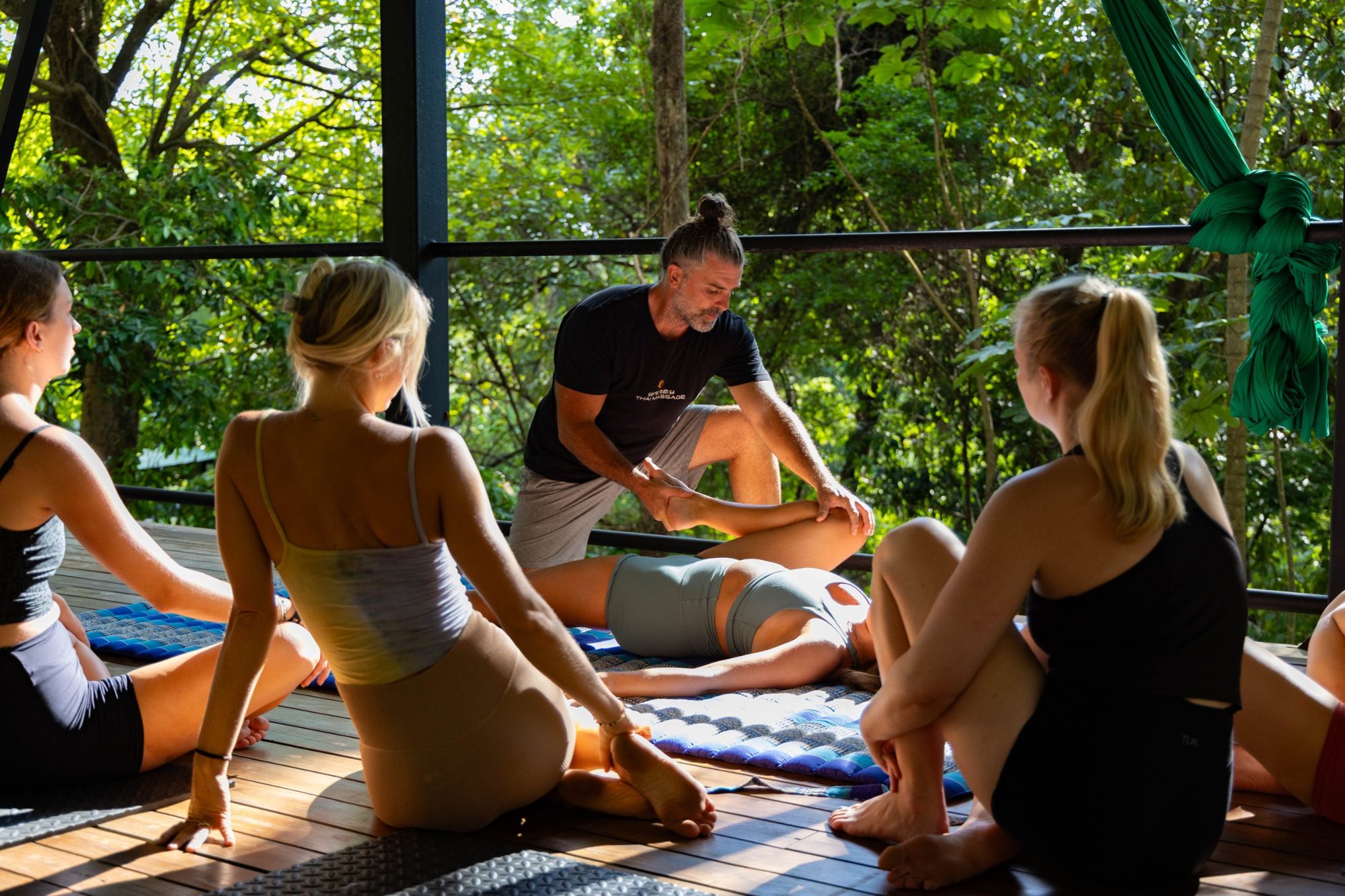
Six days on a jungle deck, hands on the mat from the first morning. Level I Foundation and Level II Intermediate together, with the video courses included and a certificate at the end.
Who this training is for
For bodyworkers who want new tools, and for people ready for a new career.
Bodyworkers & therapists
Add Thai compressions, stretching and joint work to what you already do. Your clients will feel the difference from the first session.
Career changers
No background needed. A real hands-on skill, the kind of work no AI can do for you. I left a 20-year corporate career to do this, so I know the jump.
Yoga teachers
Want Thai massage specifically for yoga? I have a separate training built around the asanas.
See the yoga teacher training →Teaching yoga?
There is a training made for you.
This training prepares therapists to build their own massage routine around each client. If you want Thai massage specifically for yoga, with every technique starting from the asana, plus joint mobilisation and muscle manipulation, look at Thai Yoga Massage for Yoga Teachers.
How you'll learn
The theory you need, and many hours on the mat.
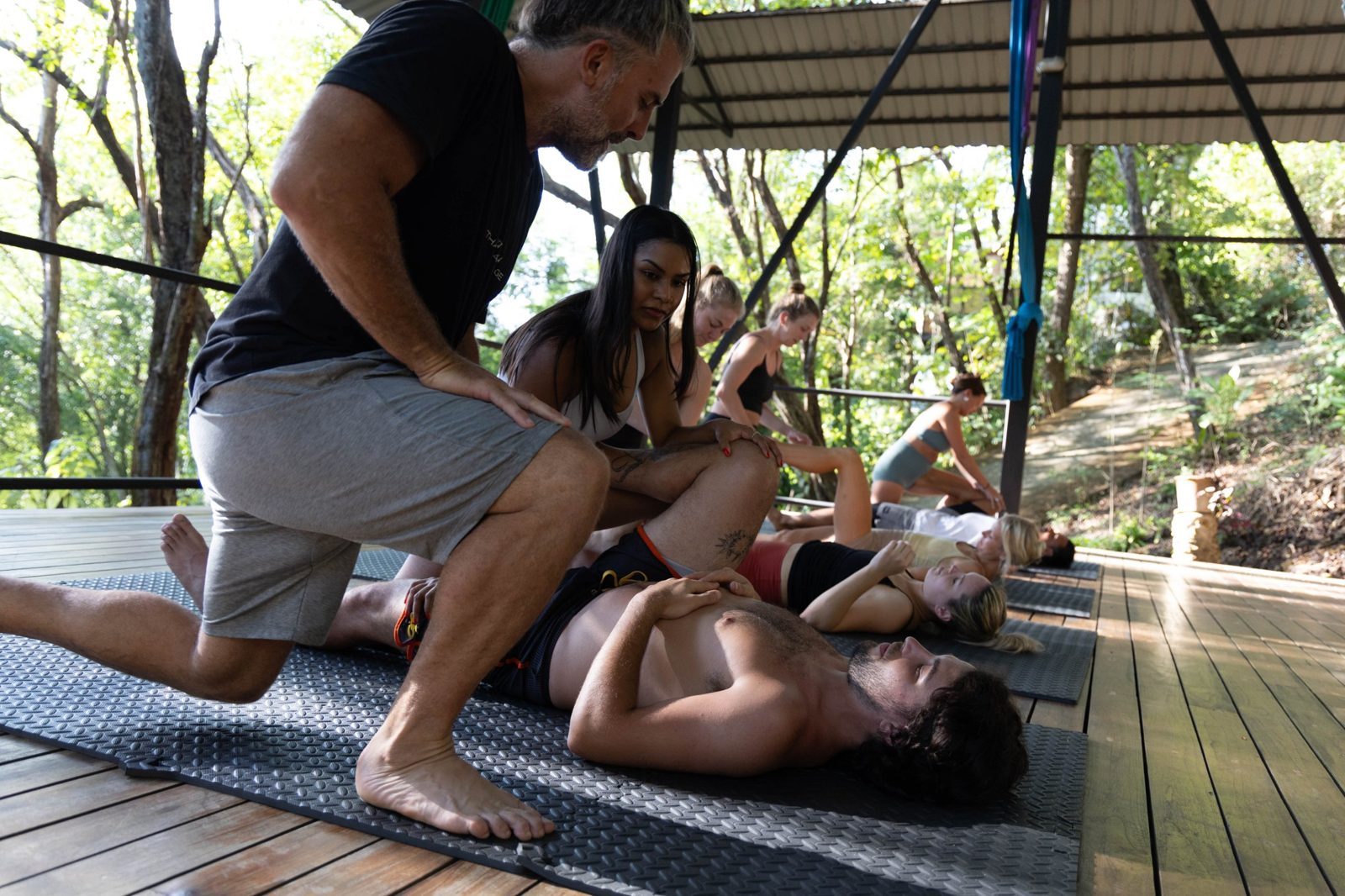
Every technique is shown, then practised in pairs while I walk around and correct you. You give and you receive, so you understand from both sides how a stretch should feel.
- Thai compressions, stretching and joint mobilisation
- The anatomy you need, explained simply, muscle by muscle
- Body mechanics: use your weight, save your hands
- How to adapt a session to surfers, runners and yogis
The method
Dynamic Functional Bodywork
Traditional Thai massage, reinterpreted for people who move. Deep tissue, Thai compressions, stretching and joint work, tailored to how each client uses their body in their sport.
The goal is simple: bring the muscles back to their place, so blood, lymph and nerves flow free and the body moves at its best.
“You have your massage when you feel well, to feel even better.”
Massage works best as prevention. When the body has no injury (no contracture, no pulled muscle, no tear) you can go deeper. Muscles become more elastic and flexible, joints gain range of motion, and the client feels no real discomfort. That's how you keep a body moving well, and keep the physio visit for much later. It's the approach you'll learn here.
Your path
Start with the foundations, then go deeper.
The core training · 6 days in person
Thai Massage Level I – Foundation
Discover the foundations of traditional Thai Massage and develop the essential skills needed to perform a structured, full-body session. This beginner-level course introduces the fundamental techniques of Thai Massage, including Sen energy lines, acupressure, rhythmic compression, muscle manipulation, and assisted stretching.
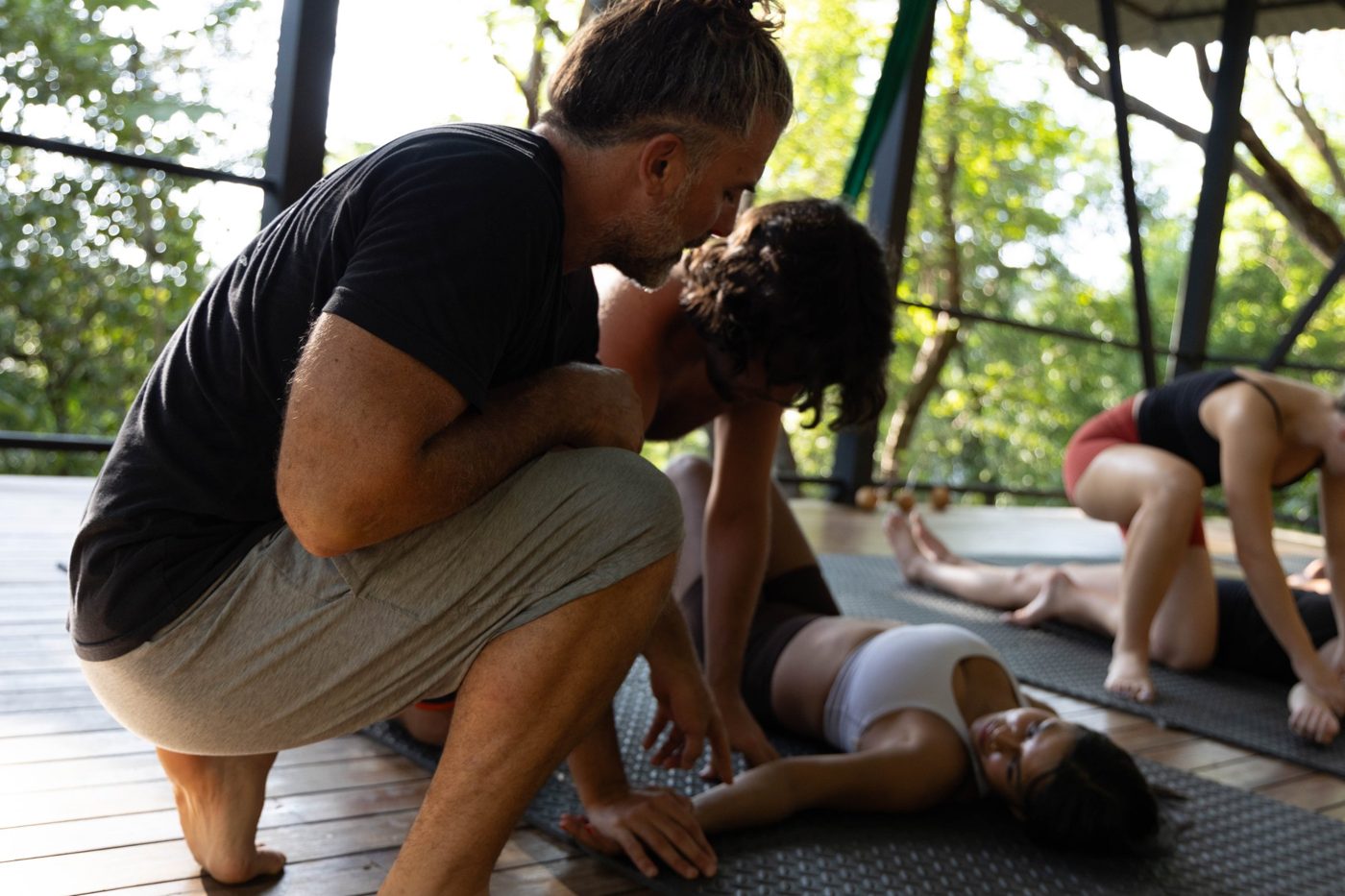
Through guided, hands-on practice, students learn essential techniques for working with the legs, hips, back, shoulders, arms, and neck, while developing proper body mechanics, pressure control, and smooth transitions between movements. Particular attention is given to using body weight, gravity, and leverage efficiently, allowing practitioners to work with greater control while reducing unnecessary physical effort.
Designed for beginners and those looking to build a solid foundation, Level I provides the essential techniques and principles needed to begin developing a confident and effective Thai Massage practice.
Thai Massage Level II – Intermediate
Build on the techniques learned in Level I and expand your repertoire with more advanced movements, additional working positions, and a greater variety of techniques. Level II explores further applications of acupressure, rhythmic compression, muscle manipulation, and assisted stretching, introducing more complex sequences and techniques performed in the prone, side-lying, and seated positions.
Students develop greater precision in positioning, leverage, pressure application, and transitions, learning how to combine individual techniques into a smooth and coherent full-body session. The training also emphasizes practitioner ergonomics and the ability to adapt techniques to different body types and individual preferences.
Designed for students who have completed foundational Thai Massage training, Level II helps practitioners become more versatile, confident, and creative in their hands-on work.
Advanced courses · 2 days each in person
Advanced Thai Stretching
Expand your Thai Massage practice with a specialized study of advanced assisted stretching techniques inspired by traditional Thai Massage and Thai Yoga Bodywork. This course introduces a wider range of stretches and variations, focusing on the hips, legs, spine, shoulders, and upper body.
Students learn how to use body positioning, leverage, controlled movement, and progressive stretching to perform techniques with greater precision and efficiency. Particular attention is given to positioning both the practitioner and the receiver, selecting appropriate variations, and transitioning smoothly between stretches. By learning to combine techniques into fluid sequences and adapt them to different body types and levels of flexibility, practitioners can develop a more versatile and creative approach to their sessions.
Ideal for experienced Thai Massage practitioners, bodyworkers, and yoga teachers who want to deepen their understanding of assisted stretching and expand their practical skills.
Thai Massage with Elbows, Knees and Feet
Expand your technical repertoire with alternative ways of applying pressure through the elbows, knees, and feet. Building on the foundations learned in Thai Massage Level I and II, this course introduces additional techniques for working more deeply into selected muscle areas while offering greater versatility when working with different body types, including larger-sized clients.
Students learn how to use body weight, leverage, positioning, and controlled pressure to work efficiently without relying on excessive muscular effort. The training explores applications for areas such as the back, hips, gluteal region, and legs, alongside techniques that incorporate the feet into Thai bodywork. Rather than relying exclusively on the hands and forearms, practitioners develop more options for adapting their approach to the person on the mat and the type of pressure required.
The emphasis is on technique, control, appropriate application, and practitioner ergonomics, giving students a broader and more adaptable set of tools to integrate into their existing Thai Massage practice.
Thai Bodywork and Joint Mobilization
Develop a more comprehensive approach to Thai Bodywork through the study of controlled joint mobilizations, gentle traction, rhythmic movements, and assisted joint mobility techniques. This training introduces practical methods for working with the natural movement of selected joints, including the hips, shoulders, ankles, wrists, and spine, within the context of Thai Massage.
Students learn how to position the body, guide movements with control, and integrate joint-focused techniques with compression and assisted stretching. Particular attention is given to movement quality, positioning, coordination, and the practitioner's use of body weight and leverage. By combining these techniques with the skills acquired in previous training, practitioners can create more varied and dynamic sessions, with additional options for adapting their work to different clients and situations.
This course is designed to complement existing Thai Massage skills and broaden the practitioner's practical repertoire.
Your teacher
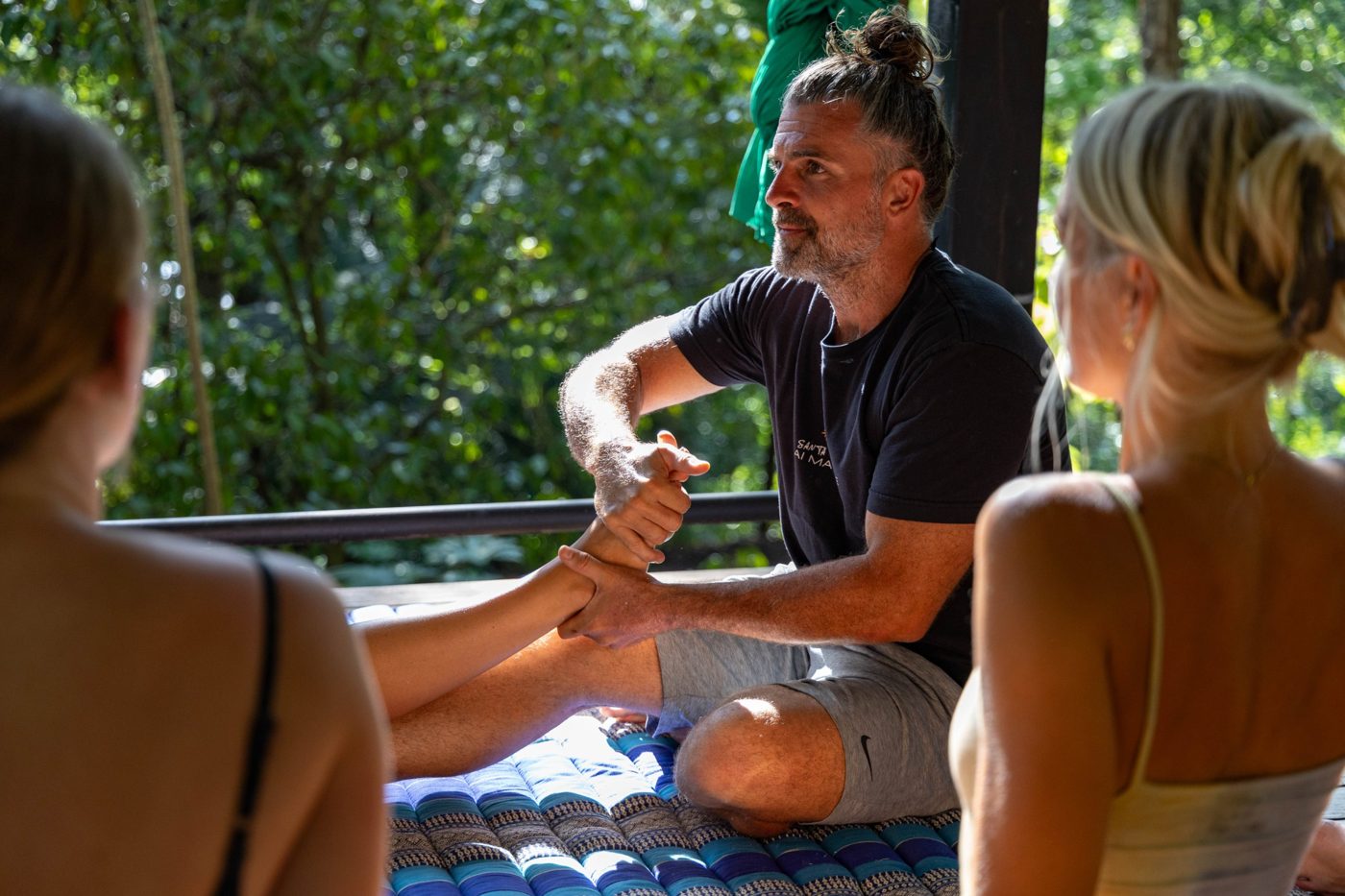
Ciao, I'm Gigi.
After 20 years in a corporate job I changed my life. I trained at the Old Medicine School and at ITM school in Chiang Mai, Thailand, then moved to Santa Teresa and opened Santa Teresa Thai Massage.
Since then I have worked on more than 2,000 clients: surfers, sport lovers, yogis and professional athletes. Everything I teach comes from that table. I'm not an anatomy professor, I'm a practitioner who shares what works.
Choose your package
Stay with us, or just come to train.
Available for every in-person training: the 6-day Level I & II and each 2-day Advanced course.
Training + stay
Your training with accommodation and meals included, for the whole length of the course. You just focus on learning, surfing and resting.
Next retreat: 3–8 May 2027
Price on request
Bring your own stay
Same training and the same certificate. You organise your own accommodation and meals in Santa Teresa.
Price on request
Getting to Santa Teresa
Joining a training? Just ask and I'll organise your transfer with my trusted local drivers.
Ready to spend a week on the deck?
Write me and I'll send you the next dates and what each package includes.